



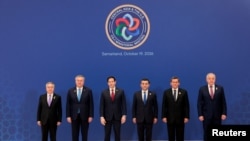
“The United States views the relationship between Uzbekistan and Central Asia as paramount to our national security and to our economic prosperity,” said Secretary of State Marco Rubio on his recent visit there for the C5+1 ministerial.
The C5+1 ministerial includes the five Central Asian republics - Kazakhstan, Kyrgyzstan, Tajikistan, Turkmenistan, and Uzbekistan - and serves as a platform for discussing economic relations, trade, energy cooperation, and security ties between the U.S. and these nations.
Under President Donald Trump and the respective leaders of the five countries, we’ve fostered a very strong relationship over the last 11 months that has yielded great accomplishments for our nations and tangible results for our people, said Secretary Rubio.
Indeed, since the C5+1 presidential summit last November “we’ve secured over $25 billion in commercial arrangements and deals between the United States and Central Asian countries, and we plan to pursue more than $100 billion more in planned trade and investment,” said Secretary Rubio.
For example, Uzbekistan has agreed to purchase 22 Boeing Dreamliners. At the same time, Uzbekistan is investing in the United States. Last year AKFA Aluminum invested $80 million in an aluminum processing facility in Kentucky, becoming the first Uzbek manufacturer to operate in the United States.
Both nations signed a bilateral critical minerals memorandum of understanding aimed at securing key supplies of uranium and other natural resources. Moreover, a new joint Business and Investment Council has brought major U.S. companies like Apple, Google, and PepsiCo to the region.
“And we want to build on this outstanding relationship,” said Secretary Rubio. That includes aligning our regulations, building transportation infrastructure, using trusted advanced technology, and growing the region’s workforce so that all American companies who want to do business here have professional partners. “We want to see this region continue to thrive into the 21st century as a hub of commercial diplomacy ... because it is in our interest from both an economic standpoint and from a security standpoint as well,” Secretary Rubio said.
“Each country here at this ministerial is a unique, sovereign nation with its own interests,” acknowledged the Secretary. “We want to ... put our countries further down the path of long-term prosperity and security. ... We’re excited to work with all of our Central Asian partners to address the challenges and the opportunities of this era as we work together.”