



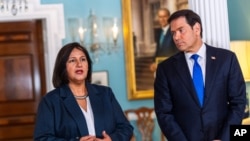
Our desire for Venezuela is that it not just have elections but build an enduring democracy, said Secretary of State Marco Rubio. Venezuela is recovering from almost a quarter century of trauma, and now is the best opportunity Venezuela has had, almost in a generation, to create a democracy for future generations. This “has to involve the participation of every sector of society,” stressed Secretary Rubio.
In recent meetings with 2015 Venezuelan National Assembly President Dinorah Figuera, Secretary Rubio expressed “100 percent support” for the political reconciliation talks she is leading. “And we encourage everyone who cares about the future of Venezuela to participate in this process in a way that’s positive.”
Two rounds of talks have already taken place, bringing together Ms. Figuera, and representatives of the interim government, led by current National Assembly President Jorge Rodríguez. The 2015 National Assembly was Venezuela’s last democratically elected legislative body recognized by all Venezuelan political parties and by the international community.
The delegations held two rounds of talks in Caracas in August and September, with a third round starting on October 14.
Following the first two rounds of talks, the 2026 National Assembly published a law reforming the Supreme Court selection process. The Supreme Court will adjudicate any challenges to Venezuela’s future election results.
The talks led to the creation of a seven-member Credentials Council that will screen candidates and send only qualified jurists to the Judicial Nominations Committee. Importantly, the 2015 National Assembly chose a majority of the Council.
The interim government has restored or partially restored access to more than 70 previously blocked internet domains.
The National Assembly established a commission to reform and decriminalize penalties contained in the repressive 2017 Law Against Hatred, which was notorious for its use by the Nicolas Maduro regime to jail opposition leaders and regime opponents.
The law established penalties of up to 20 years in prison for the “promotion or incitement of hatred, discrimination, or violence,” although in practice it was used to punish criticism of the regime.
The interim government has released over 1,000 political prisoners since capture and arrest of Nicolas Maduro in Operation Absolute Resolve. Since the political reconciliation talks began in August, the interim government has announced the release of an additional 177 political prisoners.
Reconciliation talks will now focus on finalizing the Supreme Court selection process and providing individuals and political parties participation guarantees necessary for credible elections. Talks will also address reform of the National Electoral Council, repeal of remaining repressive laws, and opening political space so all political parties and leaders can participate in political life.
The United States will continue to support this Venezuelan-led process as it moves from dialogue to an enduring democracy.