



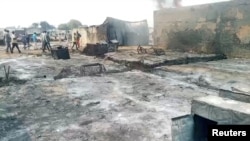
The United States condemned drone strikes that killed at least 30 people in the disputed region on the border between Sudan and South Sudan last month and called for new steps toward accountability in the Abyei Area.
The strikes hit a the vital Amiet market, which is a refugee and returnee transit point. UN Peacekeeping Chief Jean-Pierre Lacroix warned that the concentration of trade and people in the area was opening the door to criminal networks and armed groups and raised the alarm that threats to stability in Abyei “are evolving, extending beyond traditional intercommunal dynamics and are increasingly influenced by wider political and economic regional conflicts”.
“This horrific attack, where 11 drone strikes killed innocent civilians and destroyed critical economic infrastructure, is yet another example of how Sudan and South Sudan are failing the people of Abyei,” said Ambassador Jeff Bartos, U.S. Representative for UN Management and Reform. Ambassador Bartos expressed condolences from the U.S. to the families of those killed and commended the swift response of UN peacekeepers from the United Nations Interim Security Force for Abyei (UNISFA).
“We reiterate that attacks on civilians and civilian objects are prohibited under international humanitarian law. We call for a full, transparent, and prompt investigation, and that the perpetrators of such attacks be held accountable,” he said.
The people of Abyei, “deserve better from their leaders, and they deserve more from this Council,” said Ambassador Bartos. He pointed to two key failures that have led to conditions for this attack and those like them. First, he noted that unauthorized actors remain in the Abyei Area.
“Their presence puts civilians in a demilitarized area at grave risk,” he said. Second, Sudan and South Sudan still have not settled Abyei’s final status or implemented the political and security arrangements they committed to in the 2011 Agreement.
“The parties must move quickly to ensure Abyei remains stable by withdrawing all unauthorized forces,” he said. He also called on the parties to issue visas for all UN police, convene the regular Joint Political and Security Mechanism and the Abyei Joint Oversight Committee meetings, return to negotiations on Abyei’s final status, establish the Abyei Police Service, and fully support and cooperate with the Civilian Deputy Head of Mission once appointed.
“Every one of these steps is within their power today,” he said. “The question is not whether they can. It is whether they will.”
Ambassador Bartos called on the UN Security Council to hold the parties accountable by improving benchmark language to measure real progress on demilitarization, final status, UN police deployment and security and administrative arrangements.
“We urge this Council to support these benchmarks as the people of Abyei need results, not another mandate renewal that changes nothing,” he said.
The United States will continue to press for meaningful reforms at the United Nations and will continue to stand with the civilians in the war torn region of Abyei.