



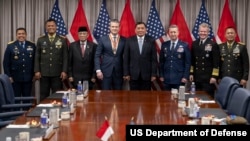
The United States and Indonesia took further steps in realizing U.S. President Donald Trump’s vision of peace through strength in the Indo-Pacific region this week, elevating their longstanding security relationship with the establishment of the Major Defense Cooperation Partnership (MDCP).
Building on defense cooperation that dates back to the 1940s and following upon a landmark economic agreement earlier this year, the new framework highlights mutual respect and national sovereignty in keeping with the U.S. National Defense Strategy.
After an honor cordon ceremony welcoming Indonesian Defense Minister Sjafrie Sjamsoeddin to the Pentagon, U.S. Secretary of Defense Pete Hegseth thanked the Indonesian government for its support of U.S. priorities and initiatives.
“Under your president's leadership, Indonesia has stepped up as a world leader. And like President Trump, your president believes in peace through strength,” said Secretary Hegseth. “I commend Indonesia's participation in the Board of Peace and for playing a leading role in the International Stabilization Force in Gaza.”
Secretary Hegseth lauded the progress the two countries have made in security cooperation, noting the completion of more than 170 military exercises each year. He highlighted a signature bilateral training program that has grown to become a large-scale, multinational joint military exercise.
“Super Garuda Shield is now one of the most important cross-domain multilateral exercises in the Indo-Pacific region,” he said. “Training and operating together show our resolve and our shared strength. Our armed forces continue to train in new and increasingly sophisticated ways.”
The new agreement will build on this success, serving as a “framework to enhance operational collaboration, partner on defense modernization, and increase training and interoperability,” wrote Chief Pentagon Spokesman Sean Parnell.
A joint statement said the two countries had agreed to explore “cutting-edge initiatives”. These include the co-development of sophisticated asymmetric capabilities in the realms of maritime, subsurface, and autonomous systems warfare. The two countries will cooperate on maintenance and repair to improve operational readiness in the region and perform joint special forces training.
“With this announcement, both nations reaffirm their shared commitment to maintaining peace and stability in the Indo-Pacific,” said the statement.
“Thank you for your commitment to advancing President Trump's goal — both of our presidents' goals of lasting peace,” said Secretary Hegseth.