



Religious based violence and kidnappings continue to plague Nigeria. Most recently, assailants attacked a church in Central Nigeria during a service, killing at least two worshippers and abducting the pastor and several others, according to press reports.
The assault came just days after 25 schoolgirls were abducted in Nigeria’s northwest state of Kebbi.
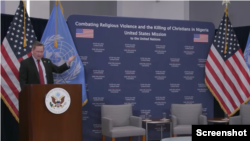
In remarks at a U.S. hosted event on “Combatting Religious Violence and the Killing of Christians in Nigeria,” U.S. Ambassador to the United Nations Mike Walz lamented the abduction of yet another group of young girls in Nigeria.
“Twenty-five little girls were ripped out of their school. I pray that we get them back. But what often happens is they’re sold into sex slavery. They’re forced to renounce their religion. They never see their homes or families again, and they literally disappear to the dark underbelly of extremism and sex slavery.”
There has been a long history of persecution of Christians in Nigeria, said Ambassador Walz.
“Churches burn. Mothers bury their children for the crime of singing Amazing Grace. . . .Pastors have been beheaded for preaching the Sermon on the Mount, entire villages wake up to gunfire, because they dare to commit the crime of calling Jesus their Lord. People go to jail under blasphemy laws for simply wearing a cross. This is not random violence. This is genocide, wearing the mask of chaos.”
Nigeria is Africa’s most populous nation and a vibrant mosaic of cultures and faiths, but it is under siege. In the northern region, there are 12 Muslim majority states that are enforcing Sharia law and have enforced it since 1999. Jihadi groups like Boko Haram and the Fulani militias continue to unleash targeted violence against Christian communities.
Open Doors, a watchdog group, ranks Nigeria seventh on its 2025 World Watch List of countries where Christians face the most extreme danger. The organization estimates Nigeria accounts for more than 80 percent of Christian deaths worldwide.
In response, the United States designated Nigeria a Country of Particular Concern for severe violations of religious freedom, spotlighting what can only be described as the government’s failure to curb these atrocities. This designation empowers the U.S. government to work with Nigeria to ensure that perpetrators of violence are held to account, people of faith are protected, and those held hostage are rescued.
“Nigerian officials maintain that terrorism strikes all faiths indiscriminately, and [it] does,” noted Ambassador Walz. Nevertheless, there is a body of evidence, stressed Ambassador Walz, that paints a very grim picture of disproportionate suffering among Christians.
“We have an entire faith that is being erased, one bullet at a time, one torched Bible at a time,” declared Ambassador Walz. “Yet, in the face of this evil, one leader has refused to look away. President Trump has made the persecuted church his priority like no other president before him in American history.” He has reminded the world that protecting Christians is not about politics. It is a moral duty.
Religious based violence and kidnappings continue to plague Nigeria. Most recently, assailants attacked a church in Central Nigeria during a service, killing at least two worshippers and abducting the pastor and several others, according to press reports.