



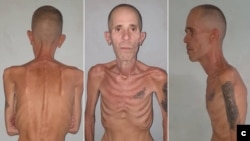
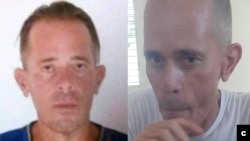
The brutality of the Cuban regime was on full display for the world to see after Prisoners Defenders, a human rights organization that tracks the status of political prisoners in Cuba, revealed a shocking photo of Alexander Díaz Rodríguez at the end of his four-year prison sentence.
Javier Larrondo, the president of Prisoners Defenders, said “When I saw the state in which [Diaz Rodríguez] was, I saw what I have seen in other occasions among prisoners freed in Cuba: they look as if they were rescued from a concentration camp.”
During his imprisonment, in 2022, Diaz Rodríguez was diagnosed with advanced thyroid cancer, but he never received adequate treatment. This was compounded later by hepatitis B, anemia, swelling in his limbs, and a worsening state of malnutrition.
“We knew he was in terrible condition and we have fought for years for his life,” said Mr. Larrondo. “He requested medical parole, we brought his case before the United Nations . . . but the Cuban regime made him serve the entire sentence,” he added.
Diaz Rodriguez was arrested following the July 11, 2021, anti-communist protests and convicted of the crimes of “disrespect” and “public disorder.”
The head of the largest known dissident group in Cuba, the Patriotic Union of Cuba, José Daniel Ferrer, published a video message on April 12, describing the photos of Díaz Rodríguez as “undeniable proof of what the penitentiary system in the Castro-communist tyranny does to political prisoners in Cuba.”
Ferrer, who is currently in exile in Florida after years of repeated imprisonment and torture in Cuba, recalled other Cuban prisoners of conscience who have reportedly suffered abuse including Roilan Alvarez, Luis Manuel Otero, and Felix Navarro.
On April 2, the Cuban government announced the release of 2,010 prisoners, framing it as a “humanitarian gesture.” While the announcement raised hopes among many political prisoners’ families, rights groups have not identified any political prisoners among those released.
According to Prisoners Defenders, Cuba is holding some 1,200 political prisoners. Cuba has been identified as the leading country for arbitrary detention since 2019 by the United Nations Working Group on Arbitrary Detention. Many of those detained, particularly following the protests on July 11, 2021, were political prisoners subjected to illegal imprisonment and unfair trials, the group confirmed.
In his executive order regarding the threat posed by Cuba to the United States, President Donald Trump said the policies, practices, and actions of the government of Cuba are “repugnant to the moral and political values of democratic and free societies and in conflict with the foreign policy of the United States to encourage peaceful change in Cuba and to promote democracy, the principle of free expression and press, the rule of law, and respect for human rights throughout the world.”