



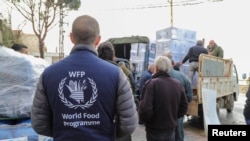
The United States remains committed to help feeding the hungry through the United Nations.
But due to growing conflicts and crises food insecurity is rising, and the humanitarian systems to address food insecurity are struggling to keep pace, warned Ambassador Jennifer Locetta, U.S. Alternative Representative for Special Political Affairs. This was the situation before the Iranian regime’s attacks in the Strait of Hormuz obstructed nearly one-quarter of global oil trade and roughly one-third of the global fertilizer trade.
“We are outraged that the Iranian regime continues its egregious and unconscionable efforts to disrupt freedom of navigation in the Strait of Hormuz,” declared Ambassador Locetta.
In Resolution 2417, the Security Council demanded that parties to a conflict not impede humanitarian assistance. Today, Iran’s actions are felt all over the world. The World Food Program now projects an additional 45 million people will suffer from acute food insecurity globally.
The Iranian regime has spiked the cost of fuel by blocking exports through the Strait. Increased energy costs hurt everyone. But in places like Syria and Gaza, increased costs threaten the precarious food security gains made by humanitarian actors and the communities they serve, noted Ambassador Locetta.
The fertilizers that Iran prevents from passing through the Strait of Hormuz are necessary for food production in sub-Saharan Africa, South Asia, and parts of Southeast Asia. The projected loss in agricultural outputs in the coming months mean less food, higher prices, and more hunger in places like Sudan, Nigeria, and the Democratic Republic of Congo, Ambassador Locetta warned.
In the DRC alone, more than 16 million people need food assistance, according to the Famine Early Warning Systems Network. Armed groups continue to attack civilians and block humanitarian routes while the Ebola outbreak threatens millions more.
In Sudan, conflict drives the world’s largest humanitarian crisis and parties to the conflict have reportedly used food access and availability as a tactic of war. The U.S. calls on all parties to this conflict to facilitate rapid, safe, and unhindered humanitarian access throughout Sudan.
But conflict is not the only threat to global food security. Natural phenomena like El Niño also risk pushing tens of millions into acute hunger.
The United States continues to partner with humanitarian organizations and governments to address, and where possible, preempt food insecurity. To that end, the U.S. recently announced more than $1 billion in U.S. assistance to UNICEF and the World Food Program to address global humanitarian, nutrition, and food security needs.
“The United States,” vowed Ambassador Locetta, “will not abandon the needy or leave them to suffer hunger.”