



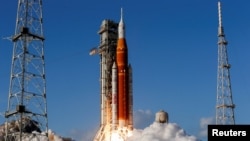
The U.S. made a giant step in its commitment to return humankind to a Golden Age of innovation and exploration last week when Artemis II successfully launched the Orion spacecraft from Cape Canaveral, Florida.
“On this historic mission, you take with you the heart of this Artemis team, the daring spirit of the American people and our partners across the globe, and the hopes and dreams of a new generation,” said Charlie Blackwell-Thompson, the launch director. “Good luck, Godspeed Artemis II. Let’s go.”
The 10-day mission marks the first time in more than 50 years that astronauts aboard a National Aeronautics and Space Administration [NASA] spacecraft have flown around the Moon. The crew that includes three Americans and one Canadian are expected to break the record set by Apollo 13 which flew 248,655 miles in 1970.
“It will be traveling further than any manned rocket has ever flown,” said U.S. President Donald Trump as he congratulated the crew on a successful launch.
The flight is a precursor in NASA’s effort to return Americans to the lunar surface by 2028. That goal is only part of an ambitious plan outlined in President Trump’s December Executive Order “Ensuring American Space Superiority,” which emphasizes U.S. leadership in space exploration, security and commerce and calls for a permanent base on the moon.
“NASA is committed to achieving the near‑impossible once again, to return to the Moon before the end of President Trump’s term, build a Moon base, establish an enduring presence, and do the other things needed to ensure American leadership in space,” said NASA Administrator Jared Isaacman.
NASA plans to increase the use of commercially procured, reusable hardware to support more frequent and affordable missions to the moon’s surface, initially targeting landings every six months as it moves toward building the base by 2030. The agency also has plans to launch the first nuclear-powered interplanetary spacecraft to Mars before the end of 2028.
These and other efforts are part of what Isaacman calls a “national imperative.”
“The clock is running in this great‑power competition, and success or failure will be measured in months, not years,” said Isaacman. “If we concentrate NASA’s extraordinary resources on the objectives of the National Space Policy, clear away needless obstacles that impede progress, and unleash the workforce and industrial might of our nation and partners, then returning to the Moon and building a base will seem pale in comparison to what we will be capable of accomplishing in the years ahead.”
“They are on the way and God bless them,” said President Trump. These are brave people. God bless those four unbelievable astronauts.”